
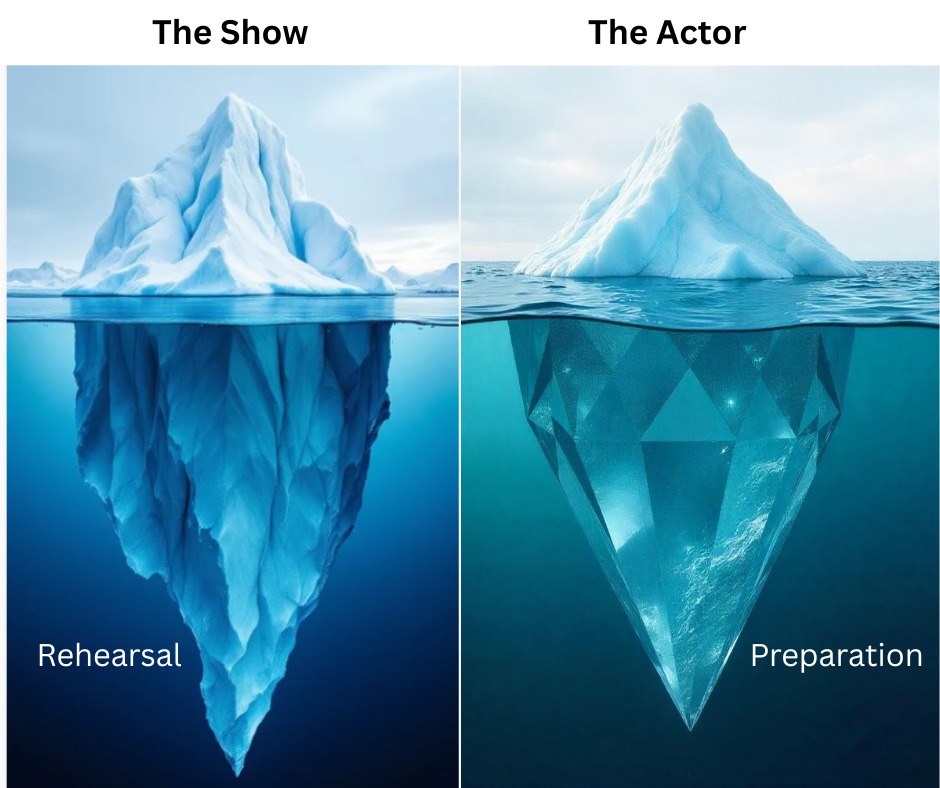
We’ve all seen this picture of an iceberg with approximately 10% above the water and 90% underneath. It often refers to the amount of rehearsal and the amount of the actual production time taken to create a play for an audience. And this illustration perfectly defines it. But what it misses is it’s not just the show that could be compared to an iceberg; it’s also the work that the actor has to do before the play even begins to be rehearsed.
An actor’s iceberg is multi-faceted, like a diamond. Rehearsals are crucial, yes, but what an actor does before they even step into the audition hall is just as crucial. Being a successful actor is 90% preparation (yes, including rehearsal) and 10% performance. Most of this 90% happens before being cast, however; it’s the work an actor needs to do in order to be ready for every audition.
There are three main areas that every stage actor needs to work on, and keep working on, to polish up their diamond. Let’s look at an overview of each over the next three posts, starting with the mind.
Surely the most important, working on your mind will make you a stronger, more well-rounded actor in every possible way.
- See plays. Not just the plays you do. Lots of plays. Plays from different genres and styles. Professional plays, Fringe plays, Indie plays. Plays with actors you don’t know. The more plays you see, the more knowledge about your industry you’ll have. Watch other actors, see how they work with a variety of moments. How do they pull focus to the right words and their meaning? How do they use stillness and silence? How long do they wait for a laugh (or not)? How do they struggle with holding back their emotions (or not)? What did you enjoy about their performance, and why? What can you learn from them? Great theatre can inspire and teach you. Bad theatre can help you really see what doesn’t work and why.
- Read plays. A big part of an actor’s job is taking the words from the script and transforming them into a stage performance. That’s known as page to stage. So it follows that the more plays you read, the more you’ll understand about plays on the page: how to read them, what to look for, how to mine the script for clues and information, and how to use all that in performance. Again, read a wide range of genres and styles, because you never know what project is coming your way, and you’ll gain an appreciation and understanding of the rich tapestry of theatrical practice. As an artist, you should love your art, and be happy to dive into all its nuances.
- Observe people. Actors are genuinely curious about people and human behaviour. It can be very instructive to sit in public, quietly, and watch how humans interact and react. I found that some places were better than others to people watch; you want somewhere were interesting and dramatic things can happen. Airports and train stations are prime locations because they are often about hellos, goodbyes, and stressful situations. Bars and cafes can work, too, of course: alcohol loosens lips and cafes are famous for blind dates. Park benches make for another good observation point. Just watch, don’t get involved, and don’t record people without their knowledge. I know it’s “legal”, but it’s not nice. Take notes if you must, but don’t be conspicuous. What pushes buttons, makes people laugh or cry, pulls them away or brings them together? Watch for the subtext vs. what they say, and how they show you both. You’ll find out a lot about people if you just listen, watch, and learn.
- Take classes. Nothing will help you as an actor more than continuing your education. Find some good teachers and take classes, every year. Take classes on scene study, character development, body and voice, acting Shakespeare, physical theatre, comedy…even the fundamentals, if you need a review and refresh…anything you can do to become a better actor and keep your skills up. Professionals take classes and never stop learning and growing. Besides, classes can get you happily through an artistic dry spell when the roles are few and far between. And most of all, classes can be FUN!
- Practice at home. Grab a play you’re unfamiliar with and dig in as if you were cast in the role you want (or a role you didn’t want, which is so very interesting and helpful). Read the play. Do the analysis and mine it for treasure. Learn your lines. Maybe get a friend involved and read scenes together. Try different things. This kind of work should be informed by a decent amount of experience and instruction, of course, but you can’t go wrong by practicing. And you may find a great monologue or learn a new technique.
- Audition, audition, audition. Actors should audition for everything, even if they’re not expecting to land a role or would not choose to accept a role in that play (I’m really pissing off directors, here, I know). You should use every audition as an opportunity to: learn more about how to have a great audition, eventually get over the insane nervousness, get used to the correct mindset going into an audition, show you and your work off to directors and casting people, and see who is in your local acting pool. But mostly you should go to practice auditioning. It’s a skill, and you need to master it.
So, give your actor brain something to work on, as often as you can, whenever you’re not in the middle of a show. You will never regret building up that artistic grey matter. It truly will make you better at what you love to do: perform.




0 Comments