

Your voice is the final facet of the actor’s diamond. It carries your thoughts, your character’s emotions, and the playwright’s words out to your scene partner(s), the world of the play, and to the audience that is eagerly listening. Without a strong, clear and supported voice, those words will go unheard and your frustrated audience will turn their suspension of disbelief off. A free, supported, and expressive voice, on the other hand, can make your performance shine. Here are some fundamentals to help you polish this side of your craft.
- Breath is the Foundation. Every sound you make begins with breath. Without the proper use and control of your breathing, you can’t sustain lines, project clearly, or manage emotional intensity on stage. The basics require diaphragmatic breathing; this is the first thing you must work on. If you aren’t sure what breathing from your diaphragm is when it comes to acting, try this:
Stand in front of a mirror and take a deep breath. If you see your shoulders rise and fall, you are not breathing from your diaphragm properly for stage work. I will do a deeper dive on this in another post (or possibly a video) another day. But just be aware that if you are not breathing down into your belly and filling up that real estate first, and if you are not controlling your breath as it comes from your belly up to your vocal chords and into your mouth, you need to work on that. Proper breath control = vocal strength, flexibility and projection, and you won’t get your words to the back row otherwise (plus, improper technique can lead to sore vocal chords).
When you learn how to breathe correctly, practice your exercises every day. Take slow inhales through the nose, make sure you are breathing down into your belly and lower back, expanding your ribs. Make sure your shoulders are not lifting. Control your exhale and release sound such as an “aaahh” or a hum. Once you’ve found your proper technique and practice it until it becomes normal, you’ll find your breath can ground and center you, help you project without strain, and give you the stamina to carry through long performances.
- Freeing the Voice. I struggle with putting this tip first, but both breath and having a relaxed instrument are crucial. You can’t produce good sound if you’re full of tension. Tension in your throat, jaw, or tongue will block good vocal production and lead to strain. Warm up your body, get into neutral position, and then warm up your voice. Gentle humming, lip trills, yawns, and tongue twisters can help release the muscles around your articulators and voice box. You should then work on resonation but humming through your chest, then lips, then your nose. Feel how the vibration. A free voice isn’t about loudness; it’s about openness and resonance.
- Articulation and Clarity. An actor must be heard and understood. This doesn’t mean over-enunciating, but it does mean training your lips, teeth, and tongue to work efficiently. Tongue twisters, exaggerated diction warm-ups, and simple consonant/vowel drills are invaluable.
In addition, watch out for these two common mistakes:
-Swooping up into your lines, as if you aren’t quite ready to speak. It’s lazy, and it can cut off important information. Think about attacking the first word from above, not swooping up from below.
-Dropping the ends of your lines is another common mistake. Your sentence may start out strong, but then the volume drops off on the last few words, once again robbing the audience of crucial information. Keep the energy and volume up without turning your line into question (unless it really is a question), and get the entire line delivered from front to back.
Think of it this way: if your audience is straining to understand you, they’ll miss the heart of your performance.
- Slow Down. Generally speaking (no pun intended) a good rate of speech if you want people to hear and understand you is about 140-150 words per minute, or thereabouts. Often, when actors get on stage they tend to rush. Don’t. You can train yourself quite easily by finding some text with about 140 words in it (nursery rhyme, story, poem, article…doesn’t really matter when it’s from) and print it out. Set a timer for one minute. Now practice reading it all by the 60 second mark. No words left over, no gaps of time at the end.
- Range and Expression. It’s easy to fall into a kind of monotone on stage, always speaking at the same pitch, volume, or rhythm. Work on expanding your pitch range with scales, your volume control with projection exercises (speaking across the room without shouting), and your rhythm with playful improvisations. Aim for vocal variety in your speech. Choose a favourite monologue and read it out loud in as many different ways as you can: fast, slow, whispering, booming, sing-song, clipped, higher pitch, lower pitch, etc. Try mixing it up. Get used to what your voice is capable of, and how you can use the different colours in your voice.
- Text Connection. Ultimately, voice is not just sound. It’s the marriage of words and intention. Once your breath, freedom, clarity, and range are in place, practice connecting them to some text, preferably with dialogue. Read plays out loud as often as you can. Try some Shakespeare, a kitchen sink drama, a farce, a romance, etc. Focus on shaping thought, emphasizing meaning, and letting the playwright’s rhythm guide you. Ask yourself questions: who are you talking to and who are they to you? Why are you talking to them about this? What do you want from them? Keep the stakes high and let yourself play, but don’t overshadow the text.
- Care and Longevity. Your voice is a delicate instrument, and it deserves care. Stay hydrated. Avoid straining by shouting in noisy environments. Warm up before rehearsals and shows, and cool down after. Figure out if certain foods cause too much mucus, or dry your throat out. Actors need to respect their voices if they want them to last for years of performances. Take care of it.
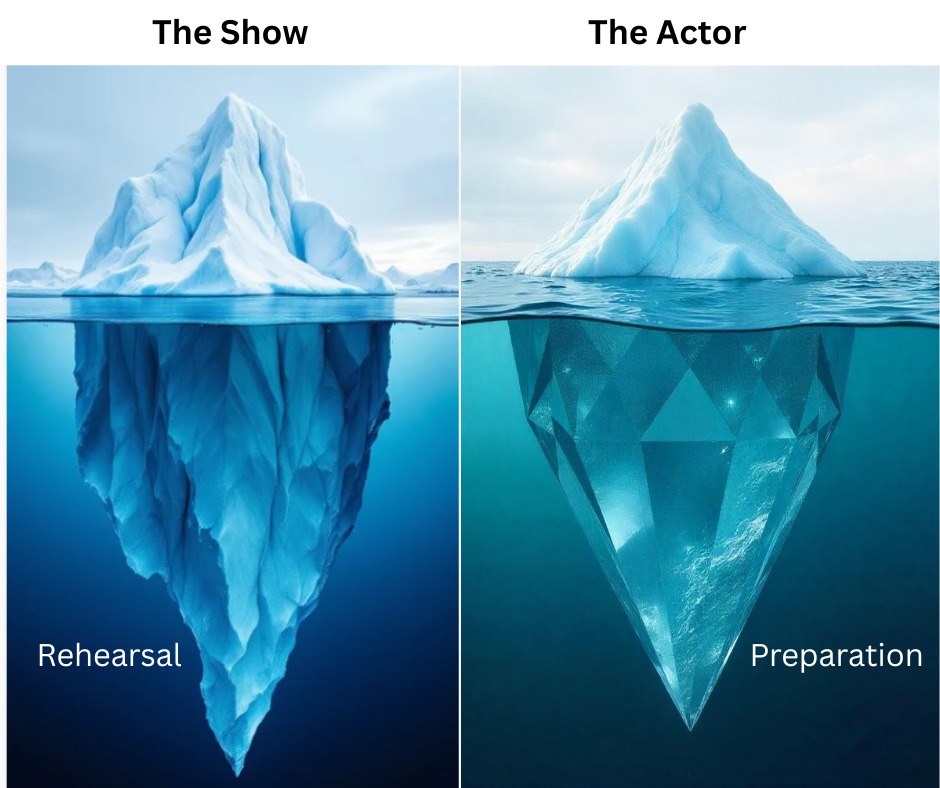
The mind, the body, and the voice — polish all three, and you’ll discover a diamond that can refract light in every direction. Each facet supports the others: a trained mind informs the choices you make, a tuned body gives those choices shape, and a liberated voice carries them into the hearts of your audience. Acting is not about a single trick or talent; it’s about crafting yourself, consistently and patiently, into the kind of artist who shines on stage. Keep working on your iceberg. Keep polishing your diamond. You and your audience will thank you for it.



0 Comments